

The following is a letter from economist James Boyce to the Joint Committee on Environment and Natural Resources in support of the Climate Superfund (H1014/S588). Professor Boyce explains why the Climate Superfund will not lead to increased gas or other fossil fuel prices.
October 23, 2025
Representative Christine Barber
Chair, Joint Committee on Environment and Natural Resources
24 Beacon St., Room 167
Boston, MA 02133
Senator Rebecca Rausch
Chair, Joint Committee on Environment and Natural Resources
24 Beacon St., Room 215
Boston, MA 02133
RE: House Bill 1014 / Senate Bill 588 – An Act establishing a climate change superfund
Dear Chair Barber, Chair Rausch, and members of the Committee:
Extreme weather events are increasing in frequency and magnitude nationwide. In Massachusetts, the most damaging events are winter storms, hurricanes, floods, and other severe storms. Statewide the cost from four major events alone in 2023 reached $2 billion, equivalent to $280 per person [1]. Vulnerable populations, including the elderly, young children, and residents living below the poverty line are especially susceptible to the resulting health impacts [2]. In coming years, these costs will grow with rising temperatures and continuing destabilization of the climate.
The costs of these extreme weather events are borne by households, businesses, local governments, and the state government. In the next three decades, the costs to Massachusetts municipal governments alone are projected to rise by $314 to $457 per person (in low-emissions and high- emissions scenarios, respectively) [3]. Federal cost-sharing has been curtailed, and the Trump administration has announced its intention to eliminate the Federal Emergency Management Agency (FEMA) after the current hurricane season [4].
In response to this dangerous situation, House Bill 1014 / Senate Bill 588, the Climate Change Adaptation Cost Recovery Act, proposes to recover part of the cost from the largest fossil fuel corporations that contributed to the crisis. The funds obtained will be allocated to adaptation and disaster recovery efforts, including state appropriations, proposals from local governments and not-for-profit and community organizations, and grants to private residents. The total amount of cost recovery demands, which is to be determined by a study conducted by the Executive Office of Energy and Environmental Affairs, will be allocated proportionally among responsible parties, firms that extracted or refined more than one billion tons of greenhouse gas emissions in the reference period 1995-2024, payable in 24 annual installments. A similar law enacted in New York set the total cost recovery at $3 billion/year over 25 years. Extrapolation based on the ratio of state GDP would yield an estimate for Massachusetts of about $1 billion/year, equivalent to about $140 per resident per year, but a thorough cost assessment could yield a higher number.
Opponents of the bill claim that these retroactive penalties would impose a “huge new expense” on Massachusetts households due to cost pass-through by the firms to consumers via higher fuel prices [5]. This threat rings hollow for two reasons explained below: (i) the responsible parties are not able to pass the cost onto consumers; and (ii) the responsible parties are not willing to do so.
I. Responsible parties are not able to pass the cost onto consumers
The prices of gasoline, natural gas, and heating oil are based on world market conditions. Gasoline prices at the pump, for example, closely track the world price of crude oil [6]. Unbranded gasoline retailers, including convenience stores, today account for more than half of all visits to gasoline stations in the northeastern states [7]. Any firm that attempts to raise its prices above the prevailing levels will lose market share.
Evidence from past liability judgments supports this conclusion. The cost of the Deepwater Horizon oil spill settlement to the firm BP, for example, amounted to roughly $65 billion [8]. This retroactive liability did not lead to higher prices at BP gas stations.
II. Responsible parties are not willing to pass the cost onto consumers
The liability of responsible parties is based on their past activities during the reference period, 1995-2024. Unlike a tax on current and future output, this does not affect the cost of supplying fuels in the market in current or future years – that is, it does not alter what economists call the “marginal cost,” or the cost of producing an additional unit of output, on which supply decisions are based [9]. To maximize current and future profits, responsible parties must continue to sell their products.
At present, the public is on the hook for the full costs of adaptation and disaster recovery. Even in the hypothetical (and quite improbable) case that responsible parties are able and willing to reimpose part or all of the assessed liability onto consumers via higher prices, the public would be no worse off than under the status quo.
Insofar as extreme-weather adaptations – such as upgrading storm water drainage, defensive improvements to roads, bridges, subways, and transit systems, and coastal flood protection – reduce subsequent disaster costs, the public will be better off than would be the case if these are not funded. Each billion dollars of annual spending on such projects has been estimated to create 7,600 jobs [10].
In sum, there is no plausible economic reason to expect that passage of the Climate Change Adaptation Cost Recovery Act will lead to higher fuel prices for Massachusetts consumers, nor that the public will be worse off as a result. I therefore recommend that you and your colleagues enact this bill for the benefit of our state’s taxpayers and residents.
Sincerely,

James K. Boyce
Professor Emeritus of Economics
Senior Fellow, Political Economy Research Institute
University of Massachusetts Amherst
References
1 – See NOAA National Centers for Environmental Information (NCEI) U.S. Billion-Dollar Weather and Climate Disasters (2025). https://www.ncei.noaa.gov/access/billions/.
2 – See Executive Office of Health and Human Services, “Extreme Weather Events.” https://www.mass.gov/info-details/extreme-weather-events.
3 – See Bo Zhao, “The Effects of Weather on Massachusetts Municipal Expenditures: Implications of Climate Change for Local Governments in New England,” Federal Reserve Bank of Boston, December 2022. https://www.bostonfed.org/publications/new-england-public-policy-center-research-report/2022/effects-of-weather-on-massachusetts-expenditures-implications-of-climate-change-in-new-england.aspx.
4 – See Bloomberg, “Trump Says FEMA Phaseout to Begin After Hurricane Season,” June 10, 2025. https://archive.is/1acED.
5 – See U.S. Chamber of Commerce, “Retroactive Penalties: A Huge New Expense for Massachusetts Households,” August 29, 2025. https://instituteforlegalreform.com/blog/retroactive-penalties-a-huge-new-expense-for-massachusetts-households/.
6 – This is shown in the following chart from the American Petroleum Institute: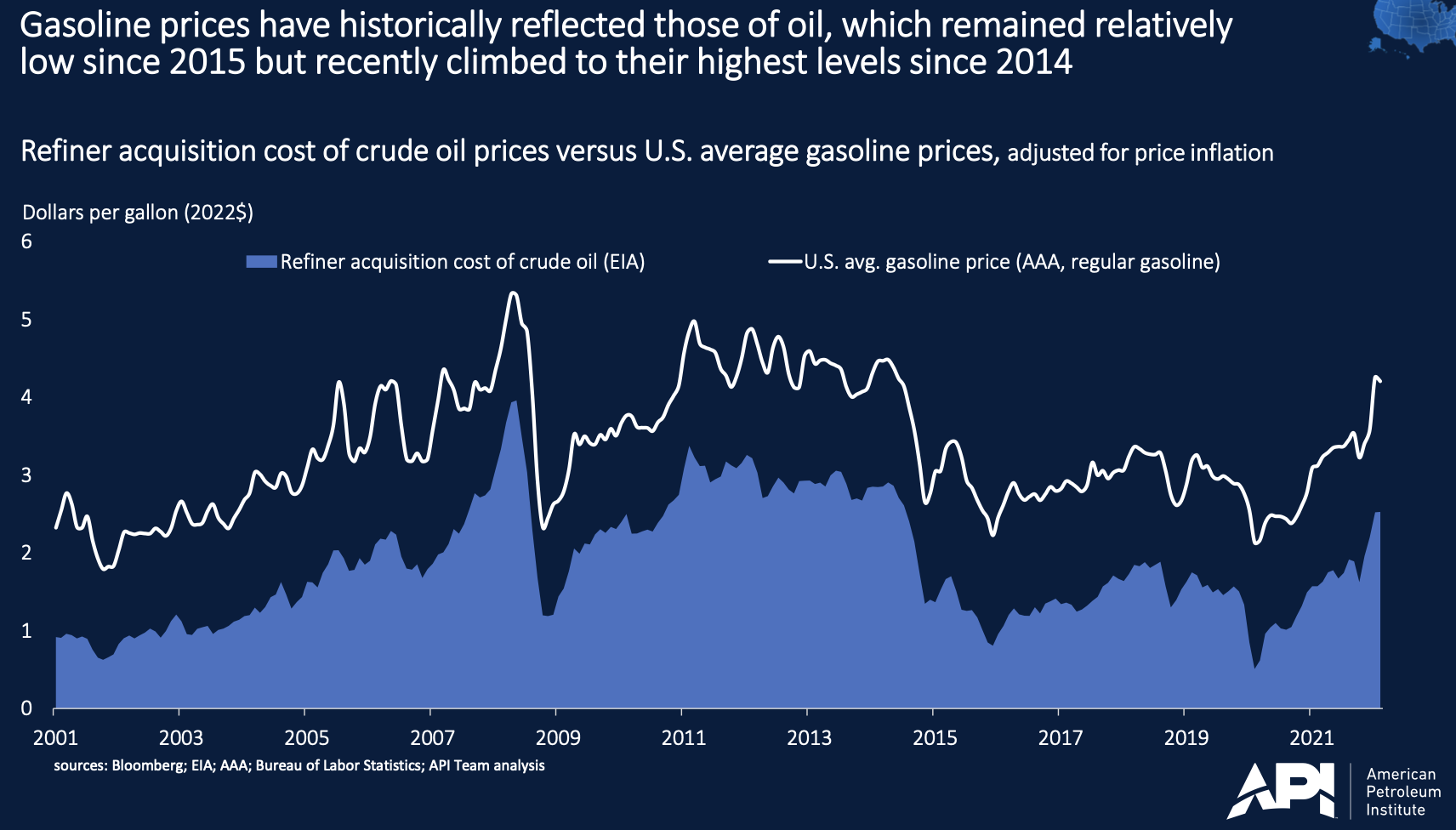
Source: API Industry Outlook, June 16, 2022. https://www.api.org/-/media/files/statistics/2022-03/api-industry-outlook-q2-2022.pdf.
7 – OPIS, “Unbranded vs Branded Gasoline: An Indicator of Consumer Preferences.” https://www.opis.com/retailcents-unbranded-vs-branded gasoline/.
8 – See Reuters, “BP Deepwater Horizon Costs Balloon to $65 Billion,” January 16, 2018. https://www.reuters.com/article/world/bp-deepwater-horizon-costs-balloon-to-65-billion-idUSKBN1F50O5/.
9 – For a more detailed account of the economic logic, see “Brief of Economists Joseph Stiglitz et al. as Amici Curiae,” filed in United States District Court for the State of Vermont, August 26, 2025. https://ecbawm.com/wp-content/uploads/2025/09/463-Final-Economists-Amicus-Brief-as-Filed.pdf.
10 – Robert Pollin and Shouvik Chakraborty, “Estimating the Job Creation Potential Through the Massachusetts Climate Adaptation Superfund Proposal,” Political Economy Research Institute, University of Massachusetts Amherst, September 2025. https://peri.umass.edu/wp-content/uploads/2025/08/Mass-Climate-Adaptation-Superfund-Report-2025.pdf.